Michele Sells Virginia
  • Home
  • Services
  • Featured Homes
  • About
  • Contact
  • Blog
  • Home
  • Services
  • Featured Homes
  • About
  • Contact
  • Blog
Search by typing & pressing enter

YOUR CART

your trusted real estate resource

Picture
       Michele Brantley 

10/1/2023 0 Comments

Your Referrals Mean the World to Me

Referrals are the lifeblood of any business, and real estate is no exception. When someone you trust refers you to a service provider, you're more likely to do business with them because you know that they've been vetted by someone you know and trust.

That's why I am so grateful for the referrals I've received from my past clients. It's a wonderful feeling to know that the work I've done has  been so appreciated.  If you know anyone who's thinking of buying or selling a home, please don't hesitate to refer them to me. I'd be honored to help them.

As an experienced real estate agent who is passionate about helping people find their dream homes, I have a proven track record of success, and I'm dedicated to providing my clients with the best possible service. I'm known for my excellent customer service and willingness to go the extra mile to help my clients achieve their goals.

Thank you for your referrals! They mean the world to us.
0 Comments
9/22/2022 1 Comment

5 Factors that affect the Sale of Any Home

Picture
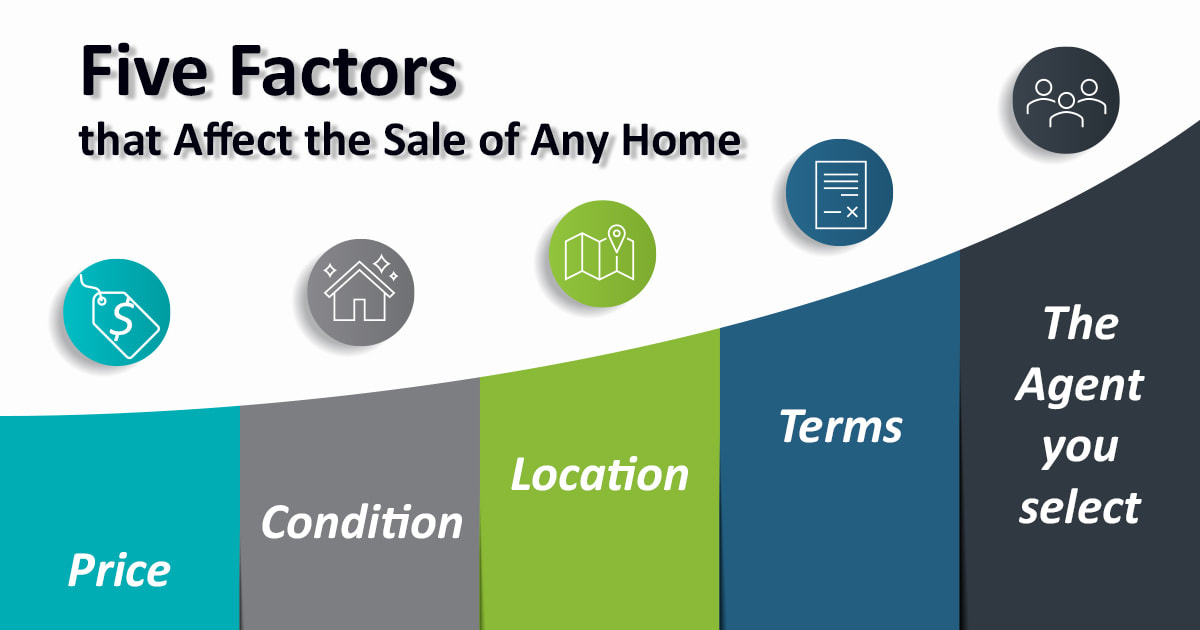
  Owners directly control four of the five factors that affect the sale of any home: price, location, condition, terms, and the agent you select.  The one thing you can't control is the location of the home, but you can adjust the other factors to compensate for failings.

   The seller controls the price of the home which determines its positioning in the marketplace.  If is priced too high, it will take longer to sell and, in some cases, for less than what it should have sold for because when it doesn't sell immediately, it is assumed that there must be an issue with it.  If it is priced too low, the owner will not realize as much of their equity as they should.

   Not pricing the home in the proper search brackets could keep the property from being exposed to potential and likely, buyers.  For example, if a home is priced at $399,000 to follow an age-old retail marketing principle, many of the most likely buyers will never know about it because they are searching for properties in the $400,000 to $450,000 range.

   The seller also controls the condition of a property which affects not only the marketability of a home but indirectly, the price.  Homes in the best condition appeal to more buyers because for the most part, they are using their available cash for the down payment and closing costs and may not be able to afford to make cosmetic or more expensive improvements to the property.

   Clutter can keep buyers from seeing your home, and more importantly, it will keep them from seeing themselves in your home.  There are three basic causes of clutter: there is too much stuff in the home; there is not enough space in the home; and there is no organization.

   Selling a home is about positioning it to sell which sometimes means temporarily or permanently getting rid of things that make the home look small or distracts the buyers from seeing its potential for them.
Terms are the financial preferences established by the seller.  In a competitive market with multiple bids, a seller may not have to offer any terms such as a financing, appraisal, or inspection contingencies.  This will restrict the number of buyers who are financially able to pay cash and are willing to do so.

   In lower price range homes, there could be a wealth of qualified buyers that need to use low down payment options, closing cost assistance from the seller, or other things.  When the seller consents to offer a variety of terms, the market of potential buyers increases.  The seller can still select the most qualified if they are not limiting protected classes.

   The fourth marketing factor that the seller controls is the agent they select to represent them in the sale of the home.  Selecting the "right" person to market your home is very important and worth careful consideration.
Your agent will be the manager of the entire marketing process. They'll position your home to be competitive with the other homes in your price range and area while attracting the broadest range of buyers possible.  Your agent will offer advice on what needs to be done before the property is offered for sale.  Your agent can also offer recommendations for a variety of service providers if work needs to be done.

   There are a lot of professionals involved in the sale of a home like lenders, title officers, appraisers, inspectors, insurance agents, surveyors, and the buyer's agent, just to name a few.  Your listing agent will coordinate the communications between the other professionals and negotiate directly with them.  Your agent's role as third party negotiator is critical and you need to feel confident in their ability to serve your best interests.

  1. Price
    • Too high; not realistic
    • Doesn't acknowledge Internet search range
  2. Location
    • A poor location can negatively affect price
    • Since location cannot change, must adjust price for a poor location
    • Condition
    • Clutter
    • Drive-up appeal
    • Deferred maintenance
    • Odors
    • Carpets
    • Lack of updates
  3. Terms (applicable to certain price ranges)
    • Buyer concessions like closing costs
    • Incentives like home warranty, appliances, floor covering, etc.
    • Buy-down interest rates
  4. The Agent you select
    • Experience
    • Knowledge of neighborhood
    • Promotional expertise
For more information, download our Sellers Guide.
1 Comment

9/7/2021 0 Comments

Equity, Price and the Agent You Select

Picture
A Seller's equity in their home is the difference between what the home is worth and what they owe.  At any point in time, it is an estimation because value is a very subjective term.  If the seller thinks the home is worth more than an actual buyer will pay for it, the estimated equity is too high.  If a buyer is willing to pay more than the seller believes the home is worth, the estimated equity is too low.

A true determination of equity becomes more objective when the home is sold, and the value is solidified by the sales price.  This value is determined by negotiations between a seller and buyer and eliminate speculation and conjecture because money and title are being exchanged.

The equity being defined above is more accurately referred to as Gross Equity.  After the ordinary and necessary expenses connected with the sale of a property are deducted from the sales price, along with any mortgage balance and/or liens, the proceeds are referred to as Net Equity. Like in business, the goal is to maximize revenue and minimize expenses, the same is true in selling a home.  The goal is to achieve the highest possible sales price while keeping the expenses as low as possible.

 Setting the price of a home is ultimately, the seller's decision .  It is critical because not only will it impact the amount of proceeds the seller realizes, but it can also affect the length of time it takes to sell, how much activity it will generate from buyers, and eventually, whether it sells at all. The cost of a home is what the seller paid for it and the improvements made.  Cost has no relationship to value.  Market value is the most probable price willing and informed buyers and sellers can agree upon in a competitive market in a reasonable period.

Price the home too low and the seller has unrealized proceeds.  Price it too high and it eliminates interested buyers.

Preparing the home to go on the market has expenses involved.  Things like painting the front door or adding landscaping to increase the initial appeal is an investment to attract the buyer's attention. While it may not add value to the home, it is an important element.

Decluttering the home takes time and may even involve temporarily renting a storage facility for things that may make your home feel smaller or detract from making your home as visually appealing as possible.
There are obviously selling expenses involved in the sale of a home which can vary based on the price of the home, what is customary in your area and negotiations in the sales contract.  Your agent can advise you on these so that you don't pay anything out of the ordinary and can provide you an estimate of what is to be expected.
Your real estate professional can provide you the information necessary to decide on price.  However, do not confuse your decision on whom to market your home by the price indicated by the market and reported by the agent. 
The market determines the value, and the seller sets the price.  Your decision in selecting an agent should be based on trust, reputation, integrity, and the ability to execute a successful marketing plan.

In today's market, on average, homes, are selling in 17 days and sellers are seeing an average of five offers.  It is not uncommon for homes to sell for more than the list price, assuming they are not priced dramatically over the market initially. Discuss with your real estate professional pricing your home slightly below market value and using a "coming soon" promotion to encourage increased buyer interest and possibly, encourage multiple offers.

0 Comments

8/23/2021 0 Comments

Understand Mortgage Forbearance

Some homeowners who could not afford to make their mortgage payments this past year have been relieved to find out that their mortgage servicer or lender allowed them to pause or possibly, reduce their payments for a limited period.  While it does relieve the financial pressure, it is a temporary remedy.
About 2/3 of the people who entered forbearance during the pandemic have exited the program.  There are only a little over two million homeowners remaining in forbearance.

It is important for owners who find that they cannot make the payments on their mortgage to contact their lender and request a forbearance.  If you stop making mortgage payments without a forbearance agreement, the servicer will report this information to the credit reporting companies, and it can have a lasting negative impact on your credit history. Without going through that process, the lender assumes you are delinquent, and protections afforded under forbearance may not apply.

Forbearance does not forgive the money that is owed.  The borrower must repay any missed or reduced payments in the future.  If forbearance was issued under the CARES Act, the lender cannot require payment in full at the end of the forbearance.  Additionally, Fannie Mae has declared "following forbearance, you are not required to repay missed payments all at once, but you have that option."

The forbearance agreement issued by the lender allows a borrower to avoid foreclosure for a period until, hopefully, the borrower's financial situation improves.  If at the end of the stated period, the borrower's hardship still exists, the lender may be able to extend the time frame.

The provisions of the forbearance vary based on the type of mortgage.  The lender can tell you the specific provisions and options. Loans made by Fannie Mae and Freddie Mac require lenders to suspend reports to credit bureaus of past due payments for borrowers in a forbearance plan and no penalties or late fees will be assessed.  Furthermore, the lender is mandated to "work with the borrower on a permanent plan to help maintain or reduce monthly payment amounts as necessary, including a loan modification."

At the end of the forbearance, there can be several options available to repay the suspended or paused amounts.  You can resume your normal payment and repayment plan can be established.  If you can start making the payment but can't afford additional payments, the missed payments could be added to the end of the loan or possibly, a secondary lien that is due and payable when you refinance, sell or terminate your mortgage.

In cases where the borrower can't afford to make the regular payments, a loan modification may be available with lower payments, but the term would be extended.  While the CARES Act does not require borrowers at the end of the forbearance period to repay skipped payments in a lump sum, if a borrower is able, they may do so. 

The purpose of this is to re-establish a payment plan that the borrower can repay the money owed.  To be eligible for a loan modification, borrowers must show they cannot make the current mortgage payments because of financial hardship while demonstrating they can meet their obligations with the proposed restructured terms.

Under the CARES Act, borrowers with a GSE-backed mortgage are entitled to an additional 180-day extension which would be a total of 360 days.  It is necessary to contact the servicer/lender for the extension. There can be both legal and tax issues concerning in forbearance and professional advice is recommended.  A list of U.S. Department of Housing and Urban Development approved Counseling agencies are available.
0 Comments

6/14/2021 0 Comments

First Love, Second Wife or Third REALTOR

There is a story of a real estate agent's prayer: "Dear Lord, if I can't be someone's first love, or second wife, at least, please let me be their third REALTOR®." 
  In a normal market with a balanced supply of sellers and buyers, this describes the preference that it might be better to be the third listing agent to help the seller after they became more realistic about their list price. In today's market, it might have more to do with buyers because of the increased competition, their chance of having an accepted offer is greatly reduced and it is only after they have lost several that they become more aggressive in the negotiations.
  Competition for homes being sold has greatly increased over the previous two years, according to a recent REALTORS® Confidence Index Survey from NAR.   In April of 2021, there were nearly five offers for every home sold which increased from two offers in 2019 and 2020. Utah reported the highest number of offers per home sold with seven while Arizona, Georgia, New Hampshire, and Washington had six.  California, Colorado, Tennessee, and Texas each had five offers per home sold. To make their offers appear more attractive, more buyers are making cash offers to eliminate financing contingencies and reduce the chance of rejection.  Cash offers represented 25% of offers in April and 21% in the first quarter of 2021 compared to 18% in 2020. Buyers who are not able to make cash offers are increasing their down payment.  Nearly half of homebuyers are putting 20% or more down during the first quarter of 2021.  Even first-time buyers are using an 80% mortgage to make their offers more attractive to sellers.
  The median days on the market for listings was 17, down from 21 days a year ago.  31% of residential sales were made to first-time homebuyers which is down from 32% in March 2021 and down from 36% one year ago. While nearly ¾ of homes closed on time, 5% were terminated and 22% were delayed but eventually went into settlement.  Appraisal and financing issues were the major contributors to the delayed transactions.  The two major factors for the terminated transactions were also appraisals and inspections issues.
  Today's environment requires a strong, sensitive agent who understands your goals as well as the intricacies of the market to be able to devise a plan to make it happen.  Your agent and their recommendations for the other professionals involved are the boots on the ground necessary whether you are a buyer or a seller.

0 Comments

2/26/2021 0 Comments

Create an Evacuation Plan for Your Pets

Picture
Picture
Picture
An evacuation plan is a necessity for every home, especially if you live in an area where fires, earthquakes, hurricanes, flooding, and other disasters are a possibility. Many homeowners create evacuation plans for their homes and practice them with their kids, but far fewer have considered one for their pets. Take these steps to add your pets to your evacuation plan.
  • ​Assign pet evacuation to an adult. Everyone should know how to act during an evacuation, and that includes assigning one parent or adult to the pets. This allows the other parent and the children to focus on their part of the evacuation plan, so there’s no confusion during a high-stress moment when time is of the essence.
  • Keep evacuation maps and pet carriers readily accessible. If you need to evacuate, you should know exactly where every important item is. If you pets require carriers, keep them in a place that you can access easily.
  • Practice your plan. Include your pets in your home evacuation drills. It’ll help you see how they will respond and make changes to your plan if necessary. Getting your dog out of a window may not be as simple as you think!
  • Be prepared in case you get separated from your pets. No matter how much you drill your evacuation plan, it’s possible that a dog or cat will run off while you’re focusing on keeping your family safe. A microchip or a GPS-compatible tag can help you find your pets once it’s safe to return to the area.
0 Comments

11/2/2020 0 Comments

Cutting Your Housing Costs in Half

Picture

Cutting the price will generally bring buyers of anything out of the woodwork that were not serious before.  Some renters could easily lower their monthly cost of housing by half or more by purchasing a home with all the financial benefits that come with it.

The most obvious thing in today's market is that the mortgage payment could be less than the rent the tenants are paying.  With mortgage rates hovering around 3%, this is a major factor of the savings.

The two other major contributing factors are appreciation and amortization of the mortgage, neither of which benefit tenants continuing to pay rent.  According to the FHFA House Price Index, home prices rose 5.4% from July 2019 to July 2020.  There were 400,000 less homes on the market during the summer of 2020 than the previous summer which is influencing appreciation. With each payment a homeowner makes on their mortgage, a portion is used to reduce the principal amount owed.  This is like a savings account for the owner because it lowers their unpaid balance and increases their equity. The equity becomes an asset that can be accessed by doing a cash-out refinance or a home equity line of credit once the equity has reached 80% loan-to-value.

A $300,000 home purchased with an FHA loan at 3% for 30 years would have a payment of approximately $2,013 including principal and interest, taxes, insurance, and mortgage insurance premium.  

If the tenant were paying $2,400 in rent, this would be a savings of almost $400 a month. The monthly principal reduction would average $500 a month for the first year which would lower the net cost of housing.  The other major item to consider would be the appreciation.  Assuming, in this example, the home was appreciating at 3% annually, the monthly appreciation in the first year would be $750 which would further lower the cost of housing.

  $2,400 Rent
  $2,013 Total House Payment
  $513  Less Monthly Principal Reduction
  $750  Less Monthly Appreciation
  $200  Plus Estimated Monthly Maintenance
-----------------------------
  $950   Net Cost of Housing

In this example, it would cost over $1,400 per month more to rent than to own. A different approach to this would be that the equity in this home in seven years would be $121,579 based on appreciation and principal reduction.  If the same person continues to rent, there would be no equity build-up.

If you're curious as to how much you could cut your housing cost, go to the Rent vs. Own or contact your real estate professional. 
​

0 Comments

6/15/2020 0 Comments

Annual Advisory

Picture
​Homeownership is a privilege and a responsibility. Even after decades of owning a home, you may still need some help to handle some of its challenges by focusing on the three "M"s of homeownership: maintenance, minimizing expenses and managing debt and risk.
While many people recognize the benefits of annual wellness, financial, vehicle and equipment maintenance visits, an important checkup that you may not have considered is an annual homeowner advisory or real estate review. Why would you treat the investment in your home with less care than you treat your car or your HVAC system?
Consider exploring the following:
  • Do you know the current value of your home? (You can, by obtaining a list of comparable sales in your immediate area, as well as what is currently on the market for sale.)
  • Have you compared your assessed value for tax purposes to the fair market value in order to possibly reduce your property taxes?
  • Even if you've refinanced in the last two years, can you save money and recapture the cost of refinancing in the length of time you plan to remain in your home?
  • Have you considered reducing your mortgage debt with low-earning cash reserves that will not be needed soon?
  • Do you have a record of the improvements you've made to your home since you purchased it? Do you know what items can be included?
  • Have you considered investing in rental homes in good neighborhoods to increase your yields and avoid the volatility of the stock market?
  • When was the last time you updated your home inventory of personal belongings? Do you have pictures as well as written documentation?
  • Do you need recommendations of repairmen and other service providers?
This service is part of my point of difference as a real estate professional to provide information to help homeowners not only when they buy and sell but all the years in between too.  My goal is to create lifelong relationships with our customers as their "go to" person whenever they have a real estate question.
My strategy is to provide reliable, consumer-based information about homeownership on a regular basis through email and social networking.  If it benefits you by helping you be a better homeowner, maybe you'll consider us your real estate professional.
When you don't know the answers to real estate questions, you know where to get them.
We're always here to serve your real estate needs. By helping you with the three "M"s of homeownership, we can earn your confidence and trust for the next time you move or a friend of yours needs a recommendation.
If you'd like to have a list of the market activity in your area or any of the other information mentioned, please contact me at (703) 952-7427 or [email protected].  We're happy to provide it along with informative guides regarding the subjects mentioned.
0 Comments

9/16/2019 1 Comment

Want to be a Landlord?

​Real estate has consistently been one of the highest rated investments available to individuals.  TV shows certainly make rentals look easy and you may even know someone who has made a lot of money with them.  Possibly, the thought has crossed your mind that if they can do it, you can too.

Before you contract for your first investment, ask yourself some questions that could save you time and energy.  Not all people have the time, the inclination or even the skill to manage property.  Landlords need to be good business people who can maximize revenue and minimize expenses.  If investors don't have the skills and talent to handle some of the repairs, they at least need to know reputable and reasonable service professionals.

Another important element is to be familiar with the state and local landlord tenant laws.  You'll need to know what are allowable security deposits and where the money can be held.  Knowing how long you have to return it to a tenant is important and what to do if you plan to keep all or part of it for damages done.  It is important to know about the eviction process and how fair housing applies.

If you decide that you may not be cut out for being a landlord, it won't eliminate investing in rentals.  It does mean that you will need to engage a property management company who is capable of dealing with all aspects of the process.  The peace of mind and convenience will cost you a fee, usually a percentage of the rent collected.  They can handle finding a tenant, doing the background check and writing the lease but there will be an additional fee for that service.

Even though your expenses will be higher with a property manager, with their experience, they should be able to help you lease the property for more money than you can get and will probably have service providers to do the work needed for less.

Occasionally, rental property requires out of pocket expenses for repairs and improvements which is like making another capital contribution.  As equity builds in a rental property due to appreciation and principal reduction, the owner does have the option to take cash out of the investment either to pay additional expenses or to use any way the owner wants.  Pulling equity out of a rental doesn't even trigger a taxable event.
Single-family homes and up to four-unit buildings offer an investor the opportunity to get a high loan-to-value mortgage at a fixed interest rate for 30 years on appreciating assets with tax advantages and reasonable control compared to other alternative investments.

Many investors like the fact that you can borrow to purchase a rental investment where many other investments require cash.  The use of borrowed funds can create an advantage called leverage.  Assume you paid cash for a $100,000 home that generated $7,000 income after the rent was collected and expenses were paid.  Divide the value of the home into the income and it would earn 7%.

If you decided to put an $80,000 mortgage on it at 5% interest, the interest expense would be $4,000 leaving only $3,000 income.  However, at that point, you'd only have $20,000 invested in the property.  Divide the cash invested into the income and the rate of return would increase to 15%.
​

This is a simple example of leverage showing that borrowed funds can increase an investor's yield on a property.
Rental property can be an excellent investment when it is treated like the business that it is.  Knowledge of the investment will reduce the risk and enhance the opportunity to make a profit.  Some investors consider their rental income as "mailbox money" because each month, they go to their mailbox and they have money being sent to them by their tenants.  The benefits of rental property can easily outweigh risk involved.
Contact me for more information on rental properties and the option to be the landlord or to delegate it to a property manager.
1 Comment

5/28/2019 0 Comments

How long do I have to wait???

Picture

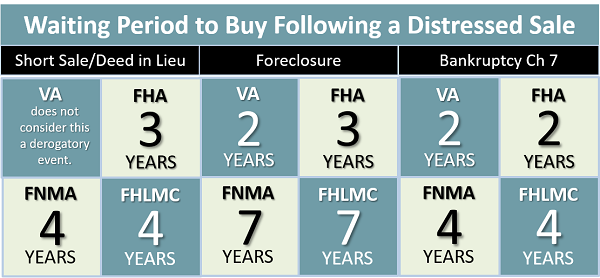
     For people who have experienced a distressed sale of a home and gotten their finances and credit back in shape, there can still be an unanswered question of "How long do we have to wait to qualify for another mortgage."  The loan types for the new loan will differ in amounts of time based on the event.  The different lending authorities, VA, FHA, Fannie Mae (FNMA) and Freddie Mac (FHLMC), establish their own waiting periods.  A borrower may be eligible to qualify for one type of mortgage before another type, even though during this waiting period, that the person was current on all payments and maintained a history of good credit. The following chart indicates how long a person might have to wait.
     A recommended lender can give you specific information regarding your individual situation and can make suggestions that will improve your ability to qualify for a mortgage.  This process should be started before looking at homes because of the time constraints listed here can vary based on current requirements and possible extenuating circumstances of your case. We want to be your personal source of real estate information and we're committed to helping from purchase to sale and all the years in between.  Call us at (703) 943-7003 for lender recommendations.

0 Comments
<<Previous

    Archives

    October 2023
    September 2022
    September 2021
    August 2021
    June 2021
    February 2021
    November 2020
    June 2020
    September 2019
    May 2019
    April 2019
    March 2019
    November 2018
    July 2018
    June 2018
    April 2018

    Categories

    All

    RSS Feed

Home

Services

Tips & News

About

Contact

Weichert, Realtors
​156 Maple E. Ave
Vienna, VA 22180
(703) 938-6070
Michele Brantley
(703)943-7003
[email protected]
[email protected]
​Licensed Associate Broker in ​Virginia and Maryland
Picture
Copyright © 2025
​